
Select your model
Get results or money back.


4.4 / 5 - Excellent


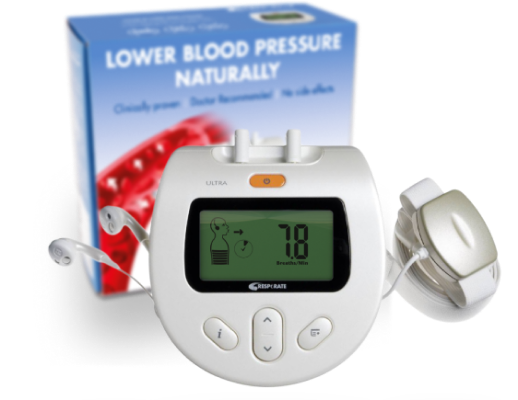
RESPeRATE Ultra
RESPeRATE for one user. Reduces high blood pressure naturally. A one-time payment of $349.95 or use Klarna to pay in 4 interest-free installments of
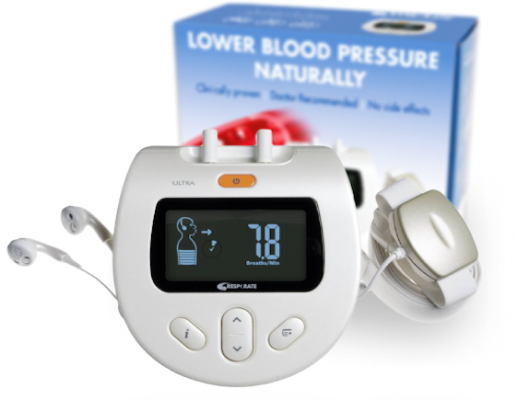
RESPeRATE Deluxe Duo
Our best model. Designed for 2 users plus has a backlight screen for easier use in the dark or in poor light. A one-time payment of $399.95 or use Klarna to pay in 4 interest-free installments of
RESPeRATE Deluxe Sleep Bundle
Save
$40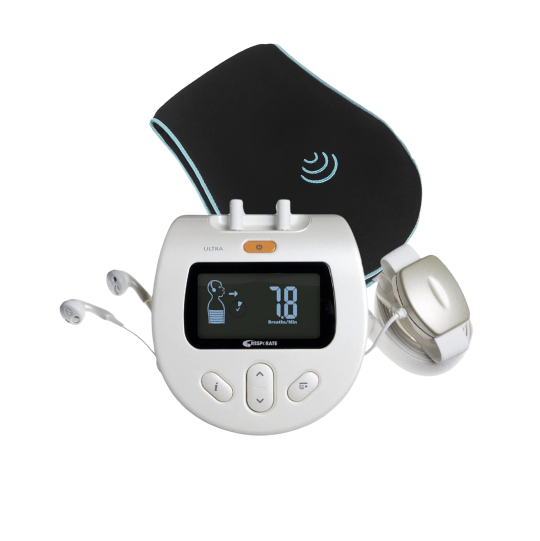
RESPeRATE Deluxe Duo + Soft-Tones
Better sleep is RESPeRATE’s only “side effect..” To further improve the experience of using RESPeRATE as you go to sleep, we created the Soft-Tones: Pillow-Top Stereo Speakers (MSRP $59.95). Sleep Bundle offer: RESPeRATE Deluxe Duo + Soft-Tones for a one-time payment of $459.90 $419 .90 or use Klarna to pay in 4 interest-free installments of just
Placed over your favorite pillow, Soft-Tones memory foam curves around your head, bringing the speakers closer to your ears, allowing you to enjoy great sound without disturbing your partner. Soft-Tones is also amazing for watching movies in bed when used with any tablet with a standard earphone jack. See
Soft-Tones details & demo
Our Commitment to Lower Your Blood Pressure
60-Days Money Back
Expriance RESPeRATE lowering your BP, risk-free. 60-days counted from the delivery date.
1-year Warranty
If something doesn’t work, just call in & we’ll replace it.

LowerPressure Program
A personalized text & email program to get the most out of RESPeRATE.

Unlimited Tech Support
Product specialists are available by phone & email. No question is too small for us.
Free Extra ($49.95 Value)
Blood Pressure eCourse
Highly rated, original, 12 weekly video lessons covering the main topics around high blood pressure and how to lower it naturally."

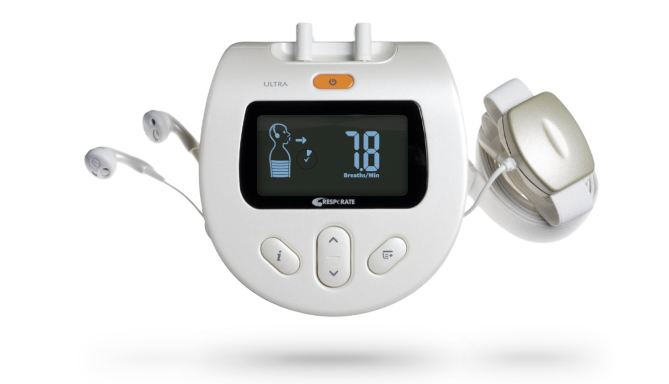
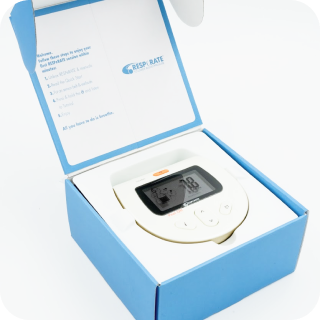
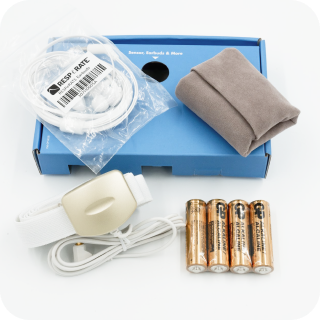
What’s In The Box
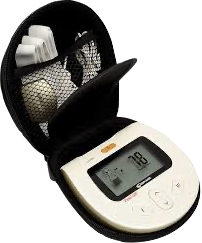
- Computerized unit
- Breathing sensor
- Earbuds
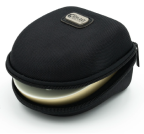
- Soft pouch
- 4 AA batteries
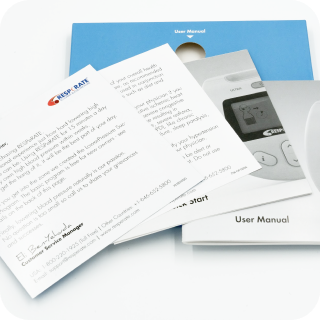
- Embedded tutorial
- User guides
Technical Specs
- Model Name:
Ultra (RR153-1M), Deluxe Duo (RR153-2DM). - Display type:
LCD - Power source:
four alkaline batteries, 1.5V (type AA) - Battery life:
At least two months, with regular use of 15 minutes per day - Maximum audio output:
10mW with 16 Ohm Ear buds - Device display respiration rate:
range of 2-42 BPM but guides between 5-20 BPM - Operating temperature:
10°C – 40°C (50°F – 104°F); Operation humidity: 30 – 75% - Storage temperature:
-10°C – 70°C (14°F – 158°F); Storage humidity: 30 – 85% - Weight:
360 grams - Outer product dimensions:
12.4 L x 11.7 W x 6.6 H cm, 4.9”Lx4.6”Wx2”.6H - Expected Service Life:
5 years - FDA market clearance:
510(k) number K020399 (OTC) – see FDA Page
Purchasing, Shipping, Taxes, Returns
Why buy directly from RESPeRATE vs. Amazon?
Because you’ll get a lower price and full 60-day money-back return policy (for any reason) without any restocking fees. We are the manufacturer of RESPeRATE so buying directly from this website or by calling us you really buy from our storefront at somewhat higher prices (to offset their fees) and you’ll only get their standard 30-day guarantee. No matter where you decide to buy, we WILL provide you unlimited phone support to ensure you lower your blood pressure.
Is there a money back guarantee? What is the return policy?
Your order is covered by our 60-Day Money Back Guarantee for ANY reason. The count begins upon the receipt of your order. See our <a> awarranty & return terms </a> and see that we are fully committed to lowering your high blood pressure.
What is the Warranty policy?
Our products come with a limited one year warranty. For more details see our Terms of Use page here
Can I share my RESPeRATE with family members?
Yes. RESPeRATE can be used by multiple people (not at the same time). But the device memory will be incorrect. The RESPeRATE Deluxe Duo model keeps separate information for two people
What forms of payment do you accept?
We accept all major credit cards and PayPal. Payments via money order and cash on delivery can be arranged by calling us at 1-800-220-1925
When is my credit card charged?
When selecting express pay or credit card, our ordering system will be charged when you place your order. Your device is typically shipped within 24 hours. When selecting Klarna pay-in-4 and/or other payment options with your PayPal account your card will be charged accordingly.
How do I know my transaction is secure?
Your credit card information is not stored in our system. We send the information directly to our safe credit card gateway, such as Stripe payments . All credit card gateways are validated Level 1 PCI DSS Compliant Service Providers. They are on Visa’s Global Compliant Provider List and MasterCard’s SDP List. We never store raw magnetic stripe, card validation code (CAV2, CID, CVC2, CVV2), or PIN block data. Storage of this data is prohibited by the PCI DSS.
Is my personal information secure?
We follow industry best practices to make sure your personal information is not inappropriately lost, misused, accessed, disclosed, altered or destroyed.
Who do I contact for billing or payment?
You can contact us on our support center page or call us at 1-800-220-1925.
Where do you ship from?
Our warehouse is located in New Jersey, USA. We also use Amazon Fulfillment Services.
Is my package insured?
Yes.
With payments, will my unit ship immediately?
Yes, we will ship you a brand new RESPeRATE with your first payment. As always, shipping is FREE and if your blood pressure is not lowered naturally within 60 days, we will refund the money paid and cancel the remaining payments.
Do you ship to international addresses?
Yes. RESPeRATE can be shipped internationally to most countries for $34.95 excluding VAT and/or other import taxes. We do not ship directly to EU countries. This is due to the fact that RESPeRATE is FDA-cleared but currently doesn’t have a CE mark. We are aware of customers that have successfully used mail forwarding services, such as www.myUS.com. Phone technical support will be provided to all our clients regardless of physical location.
4.4/5 Excellent on Verified Reviews
Click to Read Live 3rd party Verified Reviews
 Read Live Verified Reviews
Reviews
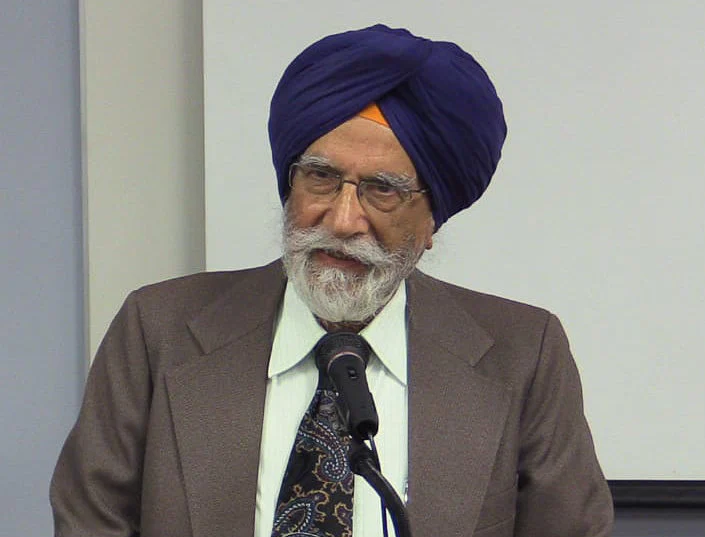
Dr. Henry Black M.D. | Past-President American Society of Hypertension
A few years ago, I read in a book how RESPeRATE can lower your blood pressure without any medical drugs. I try to avoid taking drugs as every medication, in my view, has side effects. I decided to try breathing with RESPeRATE in order to lower my blood pressure. I was in my 70’s at that time and I have a sibling younger than me who usually has high blood pressure. So I ordered two respirators from this company- one for me and one for my sibling. I have been using RESPeRATE almost everyday for 15 minutes except when I go on vacation or go to India. The RESPeRATE comes with a breathing sensor, earbuds, a user's guide, and a case. The breathing sensor senses the way you breath, and detects how you inhale and exhale and then guides you to breath slowly by playing music. It is set for 15 minutes of breathing. You can increase or decrease the time but I keep it at 15 minutes. Every night before I go to sleep, I try to use RESPeRATE. It reduces my stress and anxiety. I feel relaxed and sleep better. I have measured my blood pressure before and after using RESPeRATE and after using it, my blood pressure goes down. I have gotten used to it, I read about other breathing exercises and have tried to do those (like 4-7-8) but I don’t like those as much. I think RESPeRATE is very useful for me. I enjoy using it and feel relaxed and sleep better.
Read details
“RESPeRATE Significant Reduction!”
I have always had mild "white coat" syndrome, but my at-home blood pressure readings were consistently within normal range. However, when a medical issue occurred two years ago at age 63, my blood pressure readings in medical settings were especially high. This became a concern when trying to get medical clearance for a necessary surgical procedure that had to be scheduled at very short notice. I was prescribed blood pressure medication, but I also purchased a RESPeRATE device, in an attempt to try every way possible to be able to have the surgery. Even with an extremely short time frame, I feel that the use of the RESPeRATE device contributed significantly to bringing my blood pressure within an acceptable range to be able to go ahead with the surgery as scheduled. I was so grateful for such an important positive impact on my health that also helped me feel like I had some direct control over outcomes. I have continued to use RESPeRATE practically every day during the past two years after my surgery. It is an important part of my morning routine, and every so often, it is a nice way to end the day too! Consistent use (even during vacations) has allowed me to learn valuable breathing techniques that can be used anytime and anywhere to induce calm in stressful situations. Thank you, RESPeRATE, for such a powerful tool!
Read details
“RESPeRATE Seeing Is Believing!”
My husband and I initially purchased the Ultra RESPeRATE unit to assist him in lowering his high blood pressure. His hope was that by using the RESPeRATE he would be able to qualify for a life insurance policy. After using the RESPeRATE several times a week for several months, he was able to lower his blood pressure into the still too high 160/120 range but was then able to qualify for the insurance policy. With this success in tow, he has continued to use the RESPeRATE and has been able to lower his blood pressure even further. It is now running consistently in the 136/80 range. I was interested to see if using the RESPeRATE would help my recurring inability to fall asleep at bedtime. Almost immediately I found that I was falling asleep even before the RESPeRATE session was over. Both of us continue to use our RESPeRATE several times a week and feel it is one of the best purchases we have ever made. Seeing the results is believing in this wonderful product. Thank you RESPeRATE!
Read details
“RESPeRATE My Key To Better Health!”
It has been a long journey with RESPeRATE. I am Dr.Dilip Kharwadkar, practicing General Surgeon at city Beed in India. I am now 62 years of age. I was diagnosed with hypertension almost 20 years ago. I was very reluctant to start anti hypertensive drugs. One day while browsing the internet , I saw news about RESPeRATE and there was a demo on YouTube also. I saw the video, and immediately while listening to the melody, I felt some calmness. I received my first RESPeRATE from Israel. Since then I have been using it regularly with great effect.Few years back I contracted H1N1(swine Flu) infection. Being a Doctor I noticed my Respiratory rate was very high, so I thought why not try RESPeRATE to calm down my respiration. And believe me it worked very well. As my parasympathetic tone increased ,sympathetic overtones decreased. I recovered very fast from my illness.I recently was detected to be having Atrial Fibrillation. So I was on Anti-arrhythmic drug Carderon drip to get back the Sinus rhythm. I used RESPeRATE during my hospital stay. I reverted to Sinus rhythm very soon. I am a regular Tennis player also. I use RESPeRATE after my Tennis session. It relieves my Muscle aches to good effect. I have recently purchased my fourth RESPeRATE Machine. I recommend it to my friends as well. I think RESPeRATE use has multiple effects. It is meditative, it decreases your sympathetic overtones, it improves your circulation in lower limbs. So I used it during my long flight from Seattle to Mumbai. It definitely relieves your Anxiety.
Read details
“RESPeRATE The Key To A Healthy Blood Pressure!”
I am a 70-year-old male with high blood pressure and a previous heart blockage treated with stents. I have been using RESPeRATE every day since May of 2008, to assist me in managing my health conditions. I credit the use of RESPeRATE as part of my daily routine with helping me to maintain a high level of health for my age allowing me to continue to travel, hike, snow ski and enjoy retirement. Before I started using RESPeRATE I was on higher levels of blood pressure medications that I did not tolerate well. Side effects of these medications included numb and tingling hands and feet, fatigue and nervousness. Every afternoon I look forward to relaxing and being reminded how to breath correctly, deeply and slowly, which assists me in staying within acceptable blood pressure norms. As a long term RESPeRATE user, I have also found that the RESPeRATE breathing techniques become habit and carry forward to everyday life and result in a higher quality of sleep during the night and better overall general health. In summary, using a RESPeRATE machine for 10+ years has been key to keeping my blood pressure and stress levels down to acceptable levels and allowing me to stay active and healthy in my retirement years. I highly recommend it as an effective blood pressure control method, much superior to high doses of medication which come with a range of unpleasant side effects. Unlike medications which also lower blood pressure, the side effects of RESPeRATE- learning to relax, to focus on the moment, and to breathe correctly- are all positive.
Read details
“RESPeRATE Was My Prescription For Health!”
About 5 or so years ago I was in the pharmacy department in a local department store and decided to sit down and check my blood pressure. To my astonishment, my top number was in the low 140's while the bottom number was around 80. Not being well educated in what is a good reading and what is not, I knew that the low 140's was not good. I knew that if that was my blood pressure in a non-stressful situation, that the next time I was in my doctor's office, it would be even higher. I literally talked myself into "white coat syndrome". The next time I went to my ob-gyn, my blood pressure reading was an astounding 178/80. I was referred to my primary physician. At that doctor's office, my reading was better but still very high: 160/80. I was told to obtain a home blood pressure monitor and to monitor myself every day for a month -- once in the morning and once in the evening. I did. I was told that if my blood pressure did not come down, I might be prescribed an ace inhibitor. At the time, I had a stressful, high-demanding job which only became unbearably stressful over the years to follow. I was completely against going on medication for the rest of my life and wanted to do everything possible to avoid it. My doctor was of no assistance in guiding me on that path -- his solution was a pill. So I took matters into my own hands and did my own research. I started taking yoga classes. Despite yoga, my top readings were in the 130's to low 140. My bottom number was always in the normal range. Even though I was not overweight, I began a walking regimen which not only kept me in good health, but my dogs as well. And I Googled. It was in one of my Google searches that I found RESPeRATE. I purchased one with the idea that I'd rather spend the money on that than medication co-pays. After going through a few sessions, it calmed me. I felt so relaxed. And it even made me sleepy at a time when I suffered from insomnia. After my RESPeRATE sessions, my blood pressure decreased, and it decreased overall even not immediately following a session. It was such a nice experience that I was using the device nearly every day. I have since put in my retirement papers, and my stress level has decreased exponentially, and the top number in my readings now are typically between 110 and 116. My bottom numbers are well under 80 -- usually between 66 and 77. I totally credit RESPeRATE and an active lifestyle for that. Whenever I get the opportunity to share my story with people on how RESPeRATE has helped me, I do. I recently took a yoga teacher training class and shared it with my classmate who told me that her readings were high and that she intended to look into RESPeRATE.
Read details
“RESPeRATE Saved Me From Hypertension!”
I have been using this wonderful breathing machine for 3-4 years now. It slows my breathing down and lowers my blood pressure by up to 20 points systolic and 10-15 diastolic. It is essential with labile pressures on medication; but, it has literally saved my life when none were working or unavailable! I have a rare genetic condition which interferes with absorption of blood pressure medications (properly) and have been through many drug trials and changes, many of which would not be possible without RESPeRATE. I use it every day, sometimes up to three times a day. I started with 10 and am now up to 25 minutes per session; sometimes doubling it in one sitting, because it is so calming within minutes with tachycardia. I have learned the technique and can use it in a pinch when not at home; but, there is nothing like a session with the real thing. I am here today, solely because of RESPeRATE and wish for everyone who needs it to receive its benefits. Thank you, thank you, thank you!
Read details
“RESPeRATE My Program For Total Health!”
As part of an overall program to improve emotional, mental and physical health, I decided to incorporate meditation into my daily schedule and workout routine, as well as a technique to relax and find calmness and tranquility before drifting off to sleep. RESPeRATE is a natural companion and segue to meditation as it is quite literally a form of rhythmic deep breathing. The guiding tones are perfectly designed to help me (or anyone!) slip into a comfortable and easy pattern of deep breathing, which nearly always induces a feeling of calm and confidence. In the morning, when I use RESPeRATE as part of my meditation before work, I find that regardless of the day’s tasks and demands, that after my RESPeRATE session, I am ready to begin and handle whatever may come my way. In the evenings, as my last act before sleep, it is an excellent soporific; all natural; the only “side effect” being a sense of peace and relaxation as I glide into dreamland.
Read details
“RESPeRATE My Doctor Is Amazed!”
I am forever indebted to RESPeRATE. About 8 years ago at age 75 my blood pressure was 160 / 90. I did not like the idea of taking drugs. I Found RESPeRATE and started using it 3 times a day. Today at 83 my Blood pressure is 124/70. My doctor can not believe it! I can not recommend it enough.. It also has increased my conscious awareness. Yogis are very big on breathing in mediation. RESPeRATE makes it very easy to go into this state by visually seeing what is happening in real time. I am a real person and can be found on Facebook.
Read details
“RESPeRATE Lowered My BP Without Medication!”
I have been using RESPeRATE for over 15 years and have found this device "very effective". I'm not a person into Yoga or Meditation but I like the ease and simplicity of this mechanical breathing device. RESPeRATE along with diet and exercise practiced on a consistent basis has worked for me. Along with blood pressure reduction it also helps me when I am feeling "stressed out". I normally conduct my RESPeRATE session before going to sleep. Sometimes if the BP is creeping up a little I will add in a second session sometime during the day. I used to travel for work and it was easy to bring my RESPeRATE on my business trips. Same for vacations. Personally, I have found at the beginning of each session (when the RESPeRATE device determines your breaths per minute) I will start out by counting to 10 on my inhale and counting to 10 on my exhale. This starts me out at a lower BPM which I believe makes the session more effective. I originally was looking for a "non drug" way of lowering my blood pressure. The device's single purchase cost is about $ 300.00 and lasts for years. If you divide that $300.00 by days of use over time (2,5, 10 years) it's way lower than the cost of many prescription drugs or even a cup of coffee per day. I have recommended to anyone I know that has an issue with high blood pressure to consider adding RESPeRATE to their BP program. I'm 64 and previously never thought I would see BP readings like 115/73 and 120/68 again!
Read details
“RESPeRATE Is Just Amazing!”
After owning and using the RESPeRATE machine for more than 5 years, I thought I should share my experience with anyone considering trying it out. A friend of mine recommended it to me, and because I was already taking two different BP medications, I was open to try just about anything. As it is often the case with hypertension, my doctor was unable to find a reason, I wasn’t overweight, my diet was healthy and I worked out almost every day. I did have a fairly stressful job however. My initial experience using the RESPeRATE was amazing, I loved that it was easy to use, I could decide the length of the session and I could even take it with me wherever I went. I very quickly started to see results- My BP that previously would increase to 160-170 systolic and lower 90’s diastolic now consistently would be in the upper 120/80. Slowly but steadily, with the assistance of my doctor, and using the RESPeRATE on a daily basis, I was able to get rid of one of the BP medications. I have even since then, been able to get the dose of my other BP medication cut down to less than half of what it used to be. Clearly I would say to anyone with hypertension- don’t even think about it- just get the RESPeRATE- try it - it not only will help with your BP, but can easily work as a meditative treat at the end of long workday or a great way to start your day. Sincerely,
Read details
“RESPeRATE Really Changed My Life For The Better!”
8 years ago, I was just 47 years old, and I had a major health scare. I found out that I was not breathing deep enough to really oxygenate my body. My wife used to call me a "breath holder," and it was really bad for my health. My wife purchased a RESPeRATE for me. When I first started using it, my best rate was a super high/ super unhealthy 22 shallow breaths per minute. I quickly could see a big improvement in physical and mental health after a session on the RESPeRATE. Slow deep breaths turned me into a calm, clear thinking, and healthy person. I now relax to 4-6 deep breaths per minute. After 8 years, I own 2 RESPeRATE machines, as I keep one in my travel bag. After a long drive or flight, I take a quick 20 minute RESPeRATE break, and feel refreshed and ready for more adventures. Thanks RESPeRATE , you have really enhanced my life!
Read details
“RESPeRATE Is Lowering My Blood Pressure!”
I am in my 60s and have been using RESPeRATE for at least the last decade. During most of this period, my blood pressure has been acceptable and I have had no need for blood pressure medication. In late 2016, I appeared to have an elevated pulse rate (there are differences of opinion what is a high rate). Because I was going on a long overseas trip, lasting months, I was ‘temporarily put on Atenelol blood pressure medication, just to be safe. However, I continued to use RESPeRATE on a daily basis, exercise regularly, eat sensibly, and strive for ‘peaceful living.’ I wanted to be weaned off medication. But since I travel a lot, I waited for a period where I would be at my home for a while so as to be under a doctor’s supervision. That period came and the doctor said I could go off the medication - which did not seem to be that effective anyway. My blood pressure and pulse has been at an acceptable level for several weeks now and I give RESPeRATE the credit.
Read details
“RESPeRATE I Highly Recommend !”
I am a 75 years old retired engineer. Since my retirement my blood pressure had gone up to 140/95 which was high enough for my doctor to prescribed me 40mg of Fosinopril to control the pressure. This was a few years of progress from 5 mg to 40 mg. The doctor told me the 40 mg of Fosinopril was maxed out. In 2016 I was desperately looking for to lower my blood pressure. I read an article from Reader's Digest Oct.2017 that talked about the FDA approved device called Reperate. I have been using it since Nov. 2017 and it works well since my blood pressure was check in Doctors office last November as 124/74. I am monitoring my blood pressure along with a daily 20 min Resperate usage. I have not completely stop the Fosinopril but taking 20 mg along with Resperate. My goal is to be reduced to 10 mg and eventually NONE medication with my steadfast usage of Resperate! I highly recommend you to purchase this device.
Read details
“RESPeRATE It Soothed My Blood Pressure!”
I’ve been using Resperate for over ten years after hearing about it through an internet search and subsequent email from the company. Resperate has proven an effective natural way to control blood pressure, and is a great compliment to other good health habits such as exercise, diet and weight control. Resperate also reduces my anxiety levels. I find it meditative. Paramount is to commit to using it 4-5 days a week following the prompts, which become easy in a short time, to be sure its being used correctly for maximum benefit.
Read details
“RESPeRATE Lower My Blood Pressure!”
I was researching a natural way to lower my blood pressure after being diagnosed with severe hypertension. As a Holistic Health Coach, I had tried every natural remedy . I couldn’t find anything that worked until I found RESPeRATE. In the beginning I dismissed how effective the machine could be, but receiving the newsletters and reading about all the success stories, I promised myself to use the machine daily. Within a couple of months I had improvement in my blood pressure numbers and I was experiencing less stress. Now I see the value in using the machine daily in order to get results. Thanks RESPeRATE!
Read details
“RESPeRATE Impressed My Doctor!”
A few years ago I was diagnosed with hypertension. In looking at some conservative measures to help reduce it, we found information on RESPERATE. After using it, I discovered the substantial benefits of relaxation and lowering my blood pressure from RESPERATE for just 20 minutes every evening. Even my Internist was impressed with the Results. In addition, I find using my RESPERATE every evening before bedtime assures me of a much better quality of sleep throughout the night.I am now using it nightly is as routine as brushing my teeth. Thank you RESPeRATE!
Read details
“RESPeRATE Saved Me Money!”
I have had high BP for over 23 years and as I aged, it seemed that my medications became less effective which resulted in having to take more and stronger pills. Fortunately for me, I decided that I would search the internet for an alternative to medication. It was during that search I found the RESPeRATE website. When RESPeRATE arrived I started to use the device twice a day every day. After 3 weeks, my BP had stabilized at 122/81 a number I had not seen in quite some time, even with medication. I highly recommend this product as it has made me healthier and lowered my blood pressure remarkably. RESPeRATE has been very cost effective. In fact since using RESPeRATE it has saved me a lot of money in prescription costs. Thank You RESPeRATE. Chuck Gregorios, VA USA
Read details
“RESPeRATE Has Given Me Wellness!”
I first heard about the RESPeRATE machine from my friend who started using it approximately ten years ago to avoid going on medication to lower his blood pressure. After using it twice a week over a period of time he saw a significant difference. The RESPeRATE machine kept his blood pressure in check. He shared the good news with me. Although my blood pressure has always been in the "normal" range, I decided to order one to use as a preventive measure. During the past five years,my blood pressure has maintained and remains consistent. Aside from the lowering blood pressure component I have found it helpful in regulating my breath and meditating. It helps me unwind and the tone is extremely soothing. If I wake up in the middle of the night and have difficulty falling asleep, I merely attach the RESPeRATE device and am able to go back to sleep. What a benefit it has been for over all wellness. Consequently, I have recommended the RESPeRATE machine to a number of friends.
Read details
“RESPeRATE Has Been A Lifesaver!”
You are a Lifesaver! I was introduced to the RESPeRATE by my bio feedback Coach Tina Lerner in Santa Barbara California. I do not have high blood pressure however I struggle with anxiety. The RESPeRATE has Been a game changer in my overall health and well-being. Every morning I use the RESPeRATE before I begin my day. It has lowered my anxiety and stress. I cannot imagine starting my morning without using my RESPeRATE as it is my meditation. My auto immune disease Hashimoto’s is almost in remission due to my daily use of the resperate. I am so grateful and value this incredible game changer device.
Read details
“RESPeRATE My Primary Cure!”
Resperate was introduced to me by my husband when I was in the midst of my struggle with high blood pressure. My history was on the side of low blood pressure so this phenomenon was foreign to me. I had always been an active "high strung" person but never did I experience "high blood pressure". Meditation was frequently suggested to me but my thought was "why should I waste my time sitting quietly with zero accomplished?" In this newly discovered health condition, I was forced to assess my thoughts and take action which I did with resistance. My blood pressure is now under control and my sleep pattern has greatly improved. In fact I think at this point I think that Respirate can control one's blood pressure with as in my case minimum medication but there is no long term assistance to significantly improve one's sleep pattern with medication or any substance over the long term. I took medications galore even tried CBD as well as acupuncture but not one of these avenues was successful. The primary "cure" for my sleep was and is "Resperate". When I use this terminology however I am also indicating its use must be consistent and not sporadic. I am not a natural meditative but with the assistance of Resperate I have become a "Resperate Meditator". The melodious musical recordings resonate with my system at a success level. I encourage others with a sleep dysfunction to bite the bullet such as I have done and consistently and persistently put forth the effort to gain satisfaction with their sleep pattern via use of Resperate.
Read details
“RESPeRATE Is My Favorite Possession!”
Maybe 10 years ago my husband's coworker told him about a machine that lowers blood pressure naturally - the Resperate. He thought maybe it would help my migraines, so he bought me one. It quickly became what I referred to as "my favorite possession". I even took it on a trip to Europe, and once was questioned by a very concerned flight attendant when I called it my breathing machine. I have tied various breathing apps and different YouTube Videos. Nothing comes close to my RESPeRATE! The reason it became my favorite possession was because it was the only thing that would put me right to sleep when I desperately needed a nap after a bad night of sleep. I used to see an acupuncturist for years, for migraines (I never found a migraine cure, but over time I am doing much better). Every time the needles would go in, I'd be knocked out, fast asleep. I'd call it "going under". Well unfortunately for my acupuncturist, as soon as I discovered the Resperate, I stopped seeing her because I could put myself "under" right in my own bed. As you know, catching up on sleep is a game changer, a marriage saver. RESPeRATE gave me my life back! Thank you so much!
Read details
“RESPeRATE Gave Me Amazing Results!”
My name is Isaak Lakhin. Every year I have a check up with my doctor. In 2012, when I visited my doctor for a regular check up, he told me that I had high blood pressure 160/85. I was very astonished because I felt good. He gave me a prescription for treatment. I had to take at minimum 2 sometimes 3 tablets daily. I asked him, “Maybe there is another choice?” Because I don’t like taking tablets for treatment. So I began taking every day - lizinopropill. But I kept searching the internet looking carefully for alternative treatments for high blood pressure. Finally I found Israel company- RESPeRATE Inc and ordered - RESPeRATE. I began to use RESPeRATE every day and check my high blood pressure before and after using. My high blood pressure went down- from 164-162 to-125-120!!! I had amazing results! Last two years I take it’s only one tablet daily Sometimes I don’t take tablets for high blood pressure because I have perfect high blood pressure. I think soon I stop taking medication because I filling perfect I use Resperate every day, sometimes 2 times daily, because I have often long working day and when I go to sleep I used Resperate to relieve fatigue, stress and fall asleep. Sometimes I fall asleep with RESPeRATE and take it off Resperate only in the morning. I sent two RESPeRTAES to Russia to my close friend and my cousin they have problems with high blood pressure. Now they are happy , because RESPeRATE has helped them. When I go on vacation and have a flight abroad to Europe I always take RESPeRATE with me. I used RESPeRATE when I have long flight. I want to express my great appreciation to Dr.B Gavish and E Gavish who invented RESPeRATE. In my personal opinion I am sure that RESPeRATE can help each person in the world. Because we live in stressful times RESPeRTAE use not only helps with lowering high blood pressure Resperate helps with fatigue, headaches, and helps me to sleep. Thanks again for the amazing RESPeRATE!! My big respect to your company.
Read details
“I Highly Recommend This Device”
“ Although I have never had to take medication for high blood pressure I did not want to have to start. So I googled natural ways to lower blood pressure and that is when I found RESPeRATE. I would say I have been using RESPeRATE for over 10 years, and I have used every day. It is so simple and enjoyable. I just turn it on and follow the guiding tones and chill out. It is so very easy to use and it is a great way to start my morning. It has really helped keep my blood pressure down. I highly recommend this device. ”
Read details
“It Is A Great Way To Start The Day”
“ I have been using RESPeRATE for about two years and enjoy using it. I started using it because my blood pressure rises significantly whenever a medical professional takes it and I thought that RESPeRATE might help me with this problem and help me feel more relaxed when my blood pressure is taken. (My doctor has wired me up with a wwwice that takes my blood pressure every 15 minutes for about 20-24 hours, and the highest reading is always as it is being put in place). I believe RESPeRATE has helped me be calmer when my blood pressure is taken and helps offset that artificially high reading. More importantly, for me, RESPeRATE is like a form of mediation without the “spiritual” baggage that meditation so often involves.”
Read detailsGet our FREE 10 Tips to Lower Blood Pressure Naturally
You’ll also receive our weekly newsletter.




 Download Brochure